EIN Social Updates & Insights
Explore Enterprise Industry Network announcements, business perspectives, and updates for sellers, buyers, and business owners, alongside EIN Business Listings resources.
Explore Business Listings Insights
Read EINBL articles or watch videos about listing visibility, buyer interest, opportunity presentation, and preparing your business for the market.
Read EINBL Blog → Watch EINBL Videos →Latest EIN Social Updates
Raising Venture Capital? Size the Round Around the Milestone You Need to Reach

Nov 20, 2026
How much capital should your company raise?
For many founders, that question quickly turns into a number.
$500,000.
$2 million.
$5 million.
But a stronger starting point is not the number itself.
It is the milestone the company expects that capital to help reach.
Start With the Next Meaningful Business Milestone
A venture round should ideally connect the company’s current position with a specific stage of progress.
Depending on the business, that milestone could involve:
- Completing product development
- Launching commercially
- Reaching a meaningful revenue level
- Expanding into additional markets
- Building a sales organization
- Achieving stronger unit economics
- Completing important regulatory or technical work
- Reaching the stage needed for a future financing round
The milestone should be meaningful enough that reaching it changes the company’s position.
The Round Should Support the Journey to That Milestone
Once the target milestone is clear, founders can work backward.
What has to happen before the company gets there?
That may include:
- Hiring
- Product development
- Sales and marketing
- Technology infrastructure
- Inventory or production
- Professional services
- Regulatory work
- General operating expenses
The required capital should reflect the actual execution plan rather than an arbitrary fundraising target.
Think About Runway, Not Just Spending
The amount raised also affects how long the company can operate before it may need additional capital.
That period is often referred to as runway.
A founder should understand:
- Current cash position
- Expected monthly operating expenses
- Expected revenue during the period
- Planned hiring
- Major one-time expenditures
- Potential delays or execution setbacks
A plan that assumes everything happens exactly on schedule may leave very little room for unexpected events.
Do Not Build the Round Only Around Today’s Burn Rate
Current expenses may not represent future expenses.
If the company plans to hire engineers, salespeople or operational staff after the raise, monthly spending may increase.
The same can happen when the business moves from product development into commercial launch or expands into additional markets.
Founders should therefore model the business after the proposed investment, not only before it.
Connect Capital to Measurable Progress
Investors may want to understand what the company expects to accomplish with the proposed round.
That is different from simply presenting a list of expenses.
For example:
“We need capital for hiring and marketing” describes spending.
“We plan to build the sales organization needed to reach a defined commercial milestone” describes the intended business outcome.
The second explanation gives the capital raise more strategic context.
A Larger Round Is Not Automatically Better
Founders may be tempted to raise as much capital as possible.
But additional capital can also affect:
- Dilution
- Ownership
- Investor expectations
- Future financing strategy
- Governance
- The valuation assumptions needed to support the round
The appropriate amount depends on the business, stage, market and proposed terms.
More capital is not automatically the better outcome.
A Round That Is Too Small Can Create a Different Problem
Underestimating the capital requirement can also create risk.
If the company runs low on cash before reaching the milestone that was supposed to strengthen its position, it may have to return to the market earlier than expected.
That can happen before enough progress has been made to support the next fundraising conversation.
The fundraising target therefore needs to balance capital efficiency with the realistic cost of execution.
Include Time for Fundraising Itself
Founders should also remember that another financing process may take time.
The company should not assume that a future round will close immediately when cash becomes low.
Investor outreach, meetings, diligence, negotiations, documentation and closing can all extend the timeline.
That makes forward planning important.
Build More Than One Scenario
Instead of relying on a single forecast, founders can model several operating scenarios.
For example:
- Base case
- Slower-growth case
- Higher-expense case
This can help reveal how sensitive the capital requirement is to changes in revenue, hiring or execution timing.
Know What Happens if the Milestone Takes Longer
Every growth plan contains assumptions.
A product launch may slip.
A customer contract may take longer.
A hiring plan may change.
Market conditions may shift.
Founders should understand how those changes would affect runway and whether the company has enough flexibility to continue operating.
The Milestone Should Strengthen the Company’s Position
The next milestone should ideally create meaningful evidence of progress.
That may be stronger revenue, validated demand, improved economics, commercial traction, operational scale or another measurable development relevant to the company’s strategy.
The specific milestone depends on the business.
The objective is to avoid raising capital without a clear view of what the company should look like when that capital has been deployed.
Be Ready to Explain the Logic
When discussing a round, founders should be able to explain:
- Why this amount?
- Why now?
- How long is it expected to last?
- What will the company accomplish?
- What assumptions support the plan?
- What happens if execution is slower than expected?
- What position should the company be in when the round is substantially deployed?
Those questions connect fundraising with business execution.
Capital Is a Bridge, Not the Destination
The purpose of a venture round is not simply to put cash in the bank.
Capital should help the company move from its current position toward a more developed one.
That means founders should think about the round as a bridge:
Where are we today?
Where does this capital need to take us?
What evidence of progress should exist when we arrive?
Those questions can help make the fundraising strategy more disciplined.
EIN Venture Capital provides a starting point for businesses exploring potential capital solutions and preparing for investor conversations.
Investor appetite, valuation, dilution, financing structure, diligence, terms and investment decisions vary by company, investor and transaction. An inquiry, introduction, meeting or investor interest does not guarantee capital.
Frequently Asked Questions
How should a startup decide how much venture capital to raise?
A useful starting point is to identify the next meaningful business milestone, estimate the resources and time required to reach it, and model the resulting operating runway under realistic assumptions.
What is runway in venture capital planning?
Runway generally refers to how long a company can continue operating before its available cash is depleted, based on its cash position, revenue and spending.
Is raising more venture capital always better?
No. A larger round may provide additional operating capacity, but it can also affect dilution, ownership, governance, valuation expectations and future financing strategy.
Why should founders build multiple funding scenarios?
Different scenarios can show how changes in revenue, hiring, expenses or execution timing may affect the company’s capital requirement and runway.
Take the Next Step
Subscribe on YouTube:
https://www.youtube.com/@enterpriseindustrynetwork
Looking to raise capital for your business?
Explore Capital Solutions with EIN Venture Capital:
https://www.einvc.com/get-capital/
Exit. Acquire. Invest.
Explore Enterprise Industry Network
https://enterpriseindustrynetwork.com/
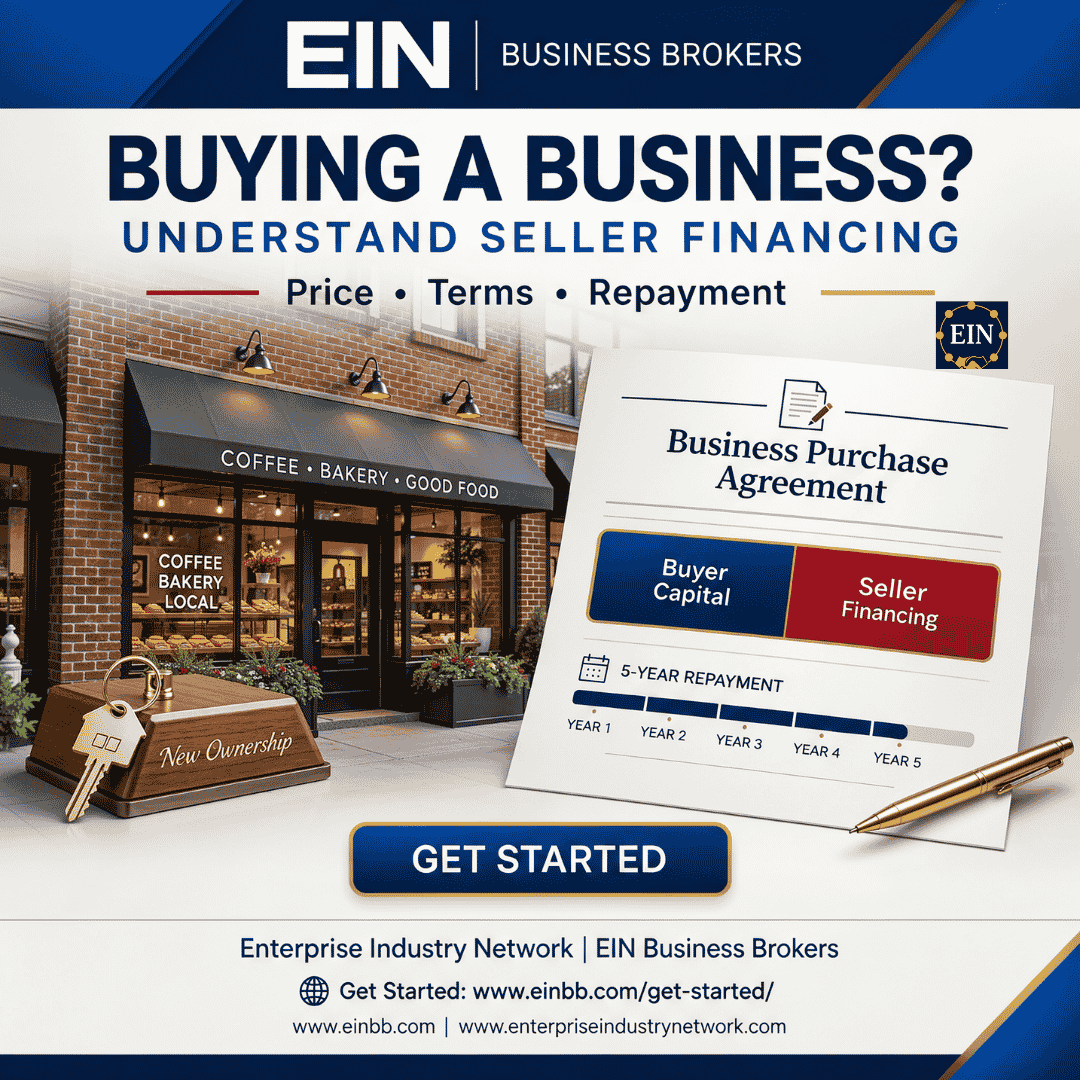
Buying a Business? Understand Seller Financing Before You Build the Deal Around It
Nov 19, 2026
Buying a business and considering seller financing?
A seller note can sometimes become part of an acquisition structure.
But buyers should not treat seller financing as simply “the seller covering part of the price.”
It is still a financial obligation with negotiated terms, repayment requirements and transaction implications.
What Is Seller Financing in a Business Acquisition?
Seller financing generally means the seller agrees to receive part of the purchase price over time instead of receiving the entire amount at closing.
The buyer typically signs a promissory note or similar agreement describing the repayment obligation.
The exact structure varies from transaction to transaction.
Why Seller Financing May Appear in a Deal
Seller financing may be discussed for several reasons.
For example, it may help:
- Bridge a gap between buyer capital and the purchase price
- Support a broader acquisition financing structure
- Provide the seller with payments over time
- Help the parties negotiate a workable transaction
None of those outcomes are automatic, and a seller is not required to finance any portion of a sale.
Start With the Amount
If seller financing is proposed, identify exactly how much of the purchase price the seller would finance.
Do not look only at the total purchase price.
Break the proposed transaction into its components, such as:
- Buyer cash or equity
- Third-party acquisition financing
- Seller financing
- Other negotiated components
This gives the buyer a clearer picture of how the acquisition would actually be funded.
Then Look at the Repayment Terms
The amount financed by the seller is only the beginning.
The buyer should understand:
- Interest rate
- Repayment period
- Payment frequency
- Amortization structure
- Whether a balloon payment exists
- When payments begin
- Whether prepayment is permitted
These terms directly affect the buyer’s future cash obligations.
Can the Business Support the Seller Note?
A seller-financed portion of the purchase price still has to be repaid.
That payment should be considered alongside:
- Operating expenses
- Payroll
- Rent or occupancy costs
- Inventory
- Taxes
- Existing or new acquisition debt
- Working-capital requirements
A deal can look affordable based on the purchase price while becoming much tighter once all post-closing obligations are considered.
Seller Financing Does Not Replace Due Diligence
A seller’s willingness to finance part of the transaction should not be treated as proof that the business is worth the asking price or that the acquisition is low risk.
The buyer should still perform appropriate financial, operational, legal and commercial due diligence.
The business itself has to justify the transaction.
Understand Security and Collateral
Depending on the negotiated structure, a seller may request security for the repayment obligation.
The transaction documents may address what happens if the buyer fails to make required payments.
These provisions can have significant legal and financial consequences.
Buyers and sellers should obtain qualified legal advice regarding promissory notes, security agreements and related transaction documents.
Seller Financing May Interact With Other Lenders
If the buyer is also using bank, SBA-backed, conventional or other third-party acquisition financing, the seller note cannot be viewed in isolation.
The primary lender may have requirements affecting how seller financing is structured.
For example, the lender may need to review:
- The amount of the seller note
- Payment timing
- Subordination
- Standby provisions where applicable
- Security position
- Other transaction terms
Specific lender requirements vary.
Do Not Assume Seller Financing Means the Seller Shares the Risk Equally
Buyers sometimes interpret seller financing as a sign that the seller is confident in the future of the business.
That may be one consideration, but it should not substitute for independent analysis.
The seller may have negotiated protections, collateral, repayment priorities or other terms that materially affect the arrangement.
Understand What Happens After Closing
The business may have a new owner after closing, but the buyer and seller can remain financially connected through the seller note.
That means the parties should understand their ongoing obligations.
Questions may include:
- Where are payments sent?
- What records must be maintained?
- What constitutes a default?
- Are there notice and cure provisions?
- Can the note be prepaid?
- Can the seller transfer the note?
- What happens if the business is later resold?
The transaction documents should clearly address the agreed terms.
Consider the Seller’s Transition Role Separately
Seller financing and seller transition support are different issues.
A seller may finance part of the purchase price and also provide training after closing.
Or the seller may do one but not the other.
Do not assume that financing automatically includes consulting, training or ongoing operational involvement.
Model the Entire Acquisition
Before agreeing to a seller-financed structure, calculate the full post-closing financial picture.
Consider:
- Purchase financing payments
- Seller-note payments
- Working capital
- Required improvements
- Inventory needs
- Owner compensation
- Unexpected operating expenses
The buyer needs enough financial capacity not only to close the transaction, but also to operate the business afterward.
Negotiate the Structure, Not Just the Price
Two offers with the same headline purchase price can produce very different outcomes.
The difference may come from:
- Cash paid at closing
- Seller financing
- Payment timing
- Contingent payments
- Working-capital treatment
- Other negotiated terms
That is why buyers should evaluate the entire transaction structure instead of focusing only on the stated price.
Seller Financing Is One Tool, Not the Whole Deal
Seller financing can sometimes help buyers and sellers create a workable acquisition structure.
But it should be reviewed with the same care as every other financial obligation.
The amount, repayment schedule, legal protections, lender requirements and effect on business cash flow all matter.
EIN Business Brokers provides a starting point for buyers exploring business acquisition opportunities and navigating the transaction process.
Seller financing availability, structure, interest, repayment terms, security, lender requirements and closing conditions vary by transaction. Buyers should obtain appropriate legal, accounting, tax and financing advice. A seller’s willingness to finance part of a transaction does not guarantee financing, valuation, profitability or closing.
Frequently Asked Questions
What does seller financing mean when buying a business?
Seller financing generally means the seller agrees to receive part of the purchase price over time, with the buyer repaying that amount according to negotiated terms.
Does seller financing reduce the amount a buyer needs at closing?
It may affect the amount due at closing, depending on the complete transaction structure. Buyers may still need their own equity, third-party financing, working capital and funds for other acquisition expenses.
Can seller financing be used with a bank or SBA-backed acquisition loan?
Potentially, but the primary lender may impose requirements affecting the seller note, including its payment timing, subordination, security or other terms. Requirements vary by lender and transaction.
Does seller financing mean the business is a good acquisition?
No. A seller’s willingness to finance part of the purchase price does not replace valuation analysis, due diligence or independent review of the business and transaction.
Take the Next Step
Subscribe on YouTube:
https://www.youtube.com/@enterpriseindustrynetwork
Looking to acquire a business?
Start with EIN Business Brokers:
https://www.einbb.com/get-started/
Exit. Acquire. Invest.
Explore Enterprise Industry Network
https://enterpriseindustrynetwork.com/
Applying for Business Funding? Review Your Existing Debt Before the Lender Does

Nov 18, 2026
Applying for business funding?
Before submitting the request, take a close look at the debt your business already has.
Lenders may review much more than the amount you want to borrow.
They may also want to understand what the business already owes, what it is currently paying each month and whether the company can reasonably support another financial obligation.
Existing Debt Is Part of the Funding Picture
A business may already have:
- Term loans
- Business lines of credit
- Business credit cards
- Equipment financing
- Vehicle financing
- Merchant financing
- SBA or bank loans
- Other recurring debt obligations
Those obligations can affect the overall funding review.
Know the Current Balance
For each existing obligation, know approximately how much remains outstanding.
A lender may want to understand the total debt position of the business rather than looking at a new request in isolation.
Make sure internal records match recent lender statements wherever possible.
Know the Monthly Payment
The monthly payment is often just as important as the outstanding balance.
A large balance with a manageable payment structure may affect the business differently from several smaller obligations that create heavy monthly cash demands.
Before applying, calculate what the business is already committed to paying every month.
Review Available Credit
If the business has revolving credit, such as a business line of credit or credit card, understand both:
- The total credit limit
- The amount currently used
A heavily utilized revolving account may present a different financial picture from an account with substantial available capacity.
Look at Debt Alongside Cash Flow
Debt should not be reviewed by itself.
The more useful question is:
How comfortably can current business cash flow support existing obligations?
A lender may evaluate whether the business has sufficient repayment capacity after considering its operating expenses and current debt payments.
Understand Debt Service
Traditional lenders may use measures such as debt service coverage when evaluating whether cash flow can support required payments.
The exact calculation and required level can vary by lender and financing product.
Business owners do not necessarily need to calculate every underwriting ratio themselves, but they should understand the underlying issue:
Does the business generate enough cash to comfortably support the debt it already has and the new financing being requested?
Do Not Forget Recently Opened Obligations
New financing, recently opened credit accounts or fresh debt can also matter.
If the business recently borrowed for equipment, expansion, inventory or another purpose, include that obligation in the overall picture.
Do not assume a recently opened account will be ignored simply because it has not appeared in older financial statements.
List Every Business Obligation Before Applying
Create a simple debt schedule before approaching a lender or funding provider.
For each obligation, record:
- Lender or provider
- Type of financing
- Original amount or credit limit
- Current balance
- Monthly payment
- Interest rate, if known
- Open date
- Remaining term, if applicable
This can make it easier to answer funding questions accurately and consistently.
Existing Debt Does Not Automatically Mean No
Having business debt does not automatically prevent a company from obtaining additional financing.
Many operating businesses use financing as part of normal business activity.
The more important issue is whether the total financial structure remains manageable.
Eligibility depends on the lender, product, business performance, cash flow, credit profile and other underwriting factors.
Ask Why the New Funding Is Needed
The purpose of the new financing also matters.
For example, the business may be seeking capital to:
- Purchase revenue-producing equipment
- Expand into a new location
- Acquire another business
- Increase inventory
- Support working capital
- Refinance or restructure eligible debt
A clear use-of-funds explanation can help show how the new obligation fits into the larger business plan.
Do Not Borrow Simply to Cover an Unsustainable Payment Structure
New financing should not automatically be viewed as the solution to every cash-flow problem.
If the business is consistently struggling to meet current obligations, adding another payment may increase pressure rather than solve the underlying issue.
Review the cause of the cash-flow shortfall first.
Check for Duplicate or Overlapping Financing
Businesses sometimes accumulate several products over time:
A credit card for inventory.
A line of credit for working capital.
An equipment loan.
A short-term product for another operating need.
Individually, each decision may have made sense at the time.
Together, they can create a more complicated debt structure.
Understanding the complete picture before applying for additional funding can help prevent surprises.
Make Sure the Application Matches the Records
If a funding application asks about existing loans, lines of credit or credit cards, provide accurate and current information.
Inconsistent or incomplete debt information can create additional questions during review.
Keep lender names, balances and payment information organized before the application begins.
Think About the New Payment Before the Approval
Do not wait until an offer arrives to ask whether the payment is affordable.
Before applying, estimate how much additional monthly debt service the business could reasonably support.
That does not determine what a lender will approve.
But it can help the owner evaluate whether a potential financing offer fits the business.
Funding Readiness Is About the Whole Financial Picture
Good funding preparation is not only about presenting revenue.
It also means understanding:
- Cash flow
- Existing debt
- Monthly obligations
- Available credit
- Repayment capacity
- The planned use of new funds
That gives the business owner a clearer picture before the lender begins its own review.
EIN Business Funding provides a starting point for U.S. business owners exploring potential funding options and preparing for lender review.
Funding availability, eligibility, limits, costs, collateral, personal guarantees and repayment terms vary by lender, product and applicant circumstances. An inquiry, prequalification or application does not guarantee financing.
Frequently Asked Questions
Do lenders look at existing business debt?
They may. Depending on the product and lender, existing debt obligations, cash flow and repayment capacity can be part of the funding review.
Does having an existing business loan prevent me from getting more funding?
Not automatically. Eligibility depends on the overall financial condition of the business, repayment ability, credit profile, lender requirements and the type of financing being requested.
What existing debt information should I prepare before applying?
It can be useful to organize lender names, account types, credit limits or original amounts, current balances, monthly payments, open dates and remaining terms where applicable.
Why does cash flow matter when a business already has debt?
Cash flow helps show whether the business can support current obligations and potentially handle an additional payment. The exact underwriting method varies by lender and product.
Take the Next Step
Subscribe on YouTube:
https://www.youtube.com/@enterpriseindustrynetwork
Explore EIN Business Funding:
https://www.einbf.com/get-funded/
Exit. Acquire. Invest.
Explore Enterprise Industry Network
https://enterpriseindustrynetwork.com/
Selling Your Business? Plan the Ownership Transition Before You Go to Market

Nov 17, 2026
Thinking about selling your business?
It is easy to focus on valuation, buyers and the closing date.
But another question can matter just as much:
What happens the day after ownership changes?
Depending on the business and transaction, a buyer may expect some level of seller transition support after closing.
Owners can benefit from deciding in advance what they are realistically willing and able to provide.
Why Transition Planning Matters
A buyer is not only acquiring historical financial performance.
The buyer may also need to understand how the business actually operates.
That can include:
- Customer relationships
- Vendor relationships
- Employee responsibilities
- Operating procedures
- Technology and systems
- Scheduling and workflow
- Industry-specific knowledge
- Other owner-held knowledge
If too much of that information exists only in the seller’s head, the transition can become more difficult.
Decide How Long You Can Stay Involved
Some sellers want a clean exit immediately after closing.
Others may be willing to remain involved for a limited transition period.
There is no single correct arrangement.
The appropriate period depends on the business, the buyer, the transaction and the parties’ negotiated expectations.
Before going to market, sellers should think about what they are comfortable offering.
Training Can Be Part of the Handoff
A buyer may need help learning company-specific processes.
Potential transition topics could include:
- Daily operating routines
- Customer-service processes
- Vendor ordering
- Pricing practices
- Employee scheduling
- Inventory procedures
- Technology systems
- Reporting practices
The more organized the business is before the sale, the easier this information may be to transfer.
Customer Introductions May Matter
In some businesses, key customer relationships are closely connected to the owner.
A buyer may therefore want help introducing the new ownership or management team.
The seller should consider which relationships may require a deliberate handoff and how those introductions should be handled.
Customer communication should be coordinated carefully so the transaction remains confidential until the appropriate stage.
Vendor and Supplier Relationships Need Attention Too
Important suppliers may also need to understand the ownership transition.
A buyer may need information about:
- Primary vendors
- Ordering procedures
- Payment terms
- Key contacts
- Supply constraints
- Contractual arrangements
A seller who has managed those relationships personally should think about how they can be transferred to the buyer.
Employee Continuity Can Affect the Transition
Employees often carry important operational knowledge.
Depending on the transaction, a buyer may want to retain key staff after closing.
Sellers should understand who performs essential functions and which responsibilities would become difficult to replace quickly.
The timing and manner of employee communication should be handled carefully and in accordance with the transaction plan and applicable requirements.
Document What the Owner Knows
Many business owners perform tasks automatically because they have been doing them for years.
The buyer may not know those routines.
Before a sale, it can be useful to document important operating information such as:
- Standard procedures
- Recurring tasks
- Key contacts
- Important passwords and access processes
- Vendor information
- Customer-service practices
- Maintenance schedules
- Other business-specific knowledge
Sensitive information should still be handled securely and shared only at the appropriate transaction stage.
Think About the Owner’s Role Before the Sale
If the owner personally handles sales, customer relationships, purchasing, hiring, operations and major decisions, the buyer may view the transition differently from a business with an established management team.
Reducing unnecessary owner dependence before going to market can help make the business easier to transfer.
Transition Support Should Be Clearly Defined
If post-closing support becomes part of the transaction, the parties should define expectations clearly.
Questions may include:
- How long will the seller remain available?
- How many hours of support are expected?
- Will support be on-site or remote?
- What subjects will the seller cover?
- Will additional consulting be compensated?
- What happens after the agreed transition period ends?
These matters should be reflected appropriately in the transaction documents with advice from qualified legal counsel.
Do Not Promise More Than You Can Deliver
A seller may be eager to keep the deal moving.
But agreeing to an unrealistic transition commitment can create problems later.
If the seller plans to retire, relocate or begin another business, those plans should be considered before agreeing to an extended post-closing role.
A Good Transition Can Protect Business Continuity
The purpose of transition planning is not to keep the seller permanently involved.
It is to help important knowledge, relationships and responsibilities move from the seller to the buyer in an orderly way.
That can support continuity for customers, employees, vendors and the business itself.
Plan the Exit Before the Closing
Before listing a business for sale, ask:
- What knowledge exists only with me?
- Which customer relationships need introduction?
- Which vendors depend on my personal involvement?
- Who runs the business when I am away?
- How much training could a buyer reasonably need?
- How long am I willing to remain involved?
Those answers can help shape both the sale process and the eventual transition.
EIN Business Brokers provides a starting point for business owners preparing for a potential sale and planning the transaction process.
Transition expectations, buyer requirements, transaction structures, legal obligations and closing outcomes vary by business and transaction. Sellers should obtain appropriate legal, accounting, tax and other professional advice. Preparing a transition plan does not guarantee buyer interest, valuation or a completed sale.
Frequently Asked Questions
Do business sellers usually stay after closing?
It depends on the transaction. Some buyers may request a short training or transition period, while other transactions may require little seller involvement after closing.
What should a seller include in a business transition plan?
A transition plan may address training, operating procedures, customer and vendor introductions, employee responsibilities, systems access and other company-specific knowledge that the buyer may need.
Should post-closing seller support be documented?
Yes. If transition support is part of the transaction, the duration, scope, availability and any compensation should be clearly addressed in the applicable transaction documents with qualified legal counsel.
Can reducing owner dependence help before selling a business?
It can improve transferability by making important responsibilities, relationships and operating knowledge less dependent on one individual. The effect on buyer interest or valuation varies by business.
Take the Next Step
Subscribe on YouTube:
https://www.youtube.com/@enterpriseindustrynetwork
Thinking about selling your business?
Get Started with EIN Business Brokers:
https://www.einbb.com/get-started/
Exit. Acquire. Invest.
Explore Enterprise Industry Network
https://enterpriseindustrynetwork.com/
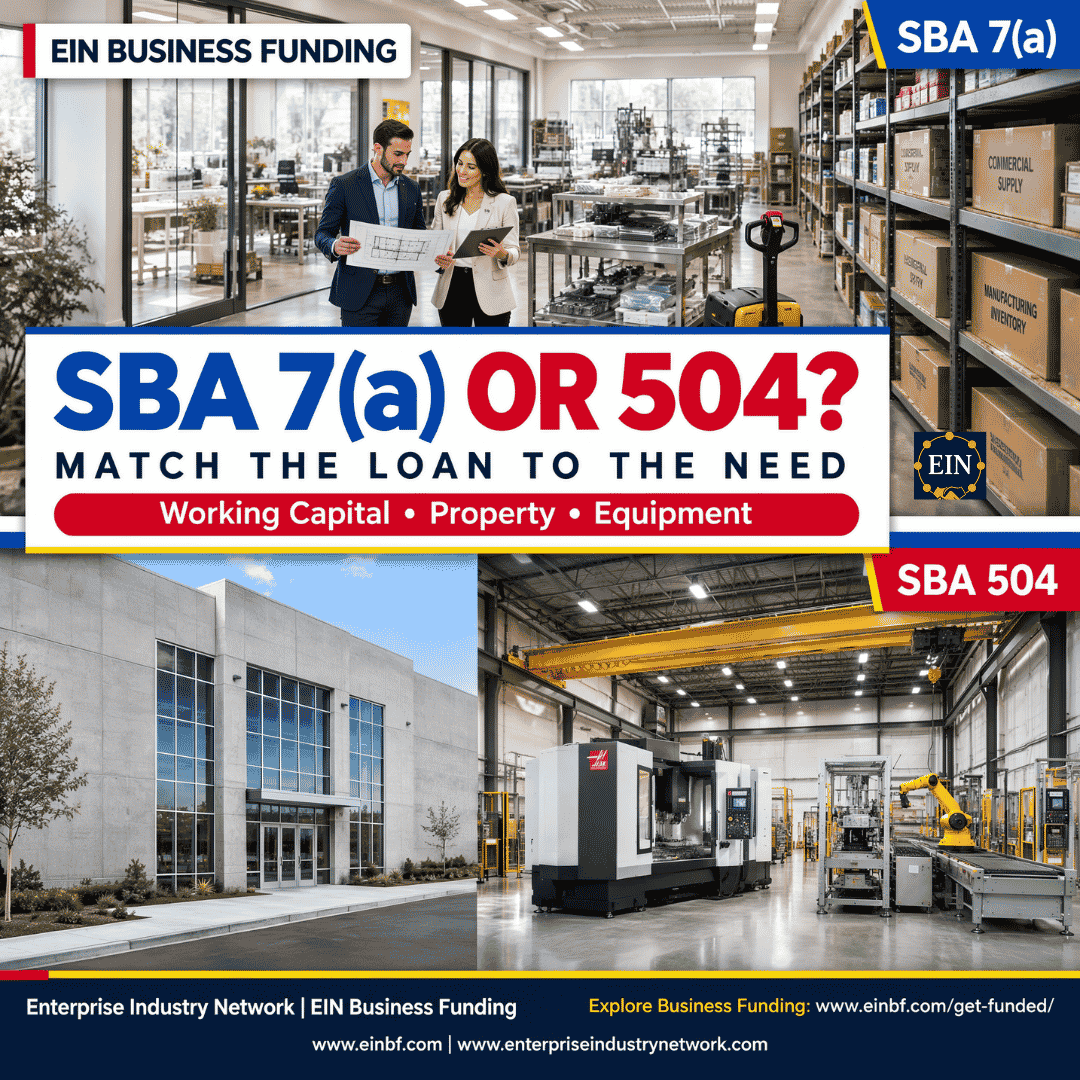
SBA Loan With an EIN: Should Your Business Explore 7(a) or 504 Financing?
Nov 16, 2026
Searching for an SBA loan with an EIN?
Before asking whether your business qualifies, start with another question:
What exactly does the business need the financing for?
Two commonly discussed SBA financing paths—7(a) and 504—can serve very different purposes.
Understanding that difference can help a business owner explore the financing path that more closely matches the planned use of funds.
What Is an SBA 7(a) Loan?
The SBA 7(a) program is the U.S. Small Business Administration’s primary business loan program.
The SBA generally does not provide the business owner with the loan proceeds directly. Instead, eligible lenders make the loans, with the SBA providing a guaranty subject to program requirements.
One reason 7(a) financing is widely considered is the range of eligible business uses.
What Can SBA 7(a) Financing Be Used For?
Depending on the transaction and program requirements, 7(a) financing may potentially support purposes such as:
- Working capital
- Purchasing machinery or equipment
- Purchasing furniture, fixtures or supplies
- Acquiring, improving or refinancing qualifying real estate
- Refinancing certain existing business debt
- Complete or partial changes of business ownership
- Multiple-purpose business financing
That flexibility can make 7(a) relevant when the financing need includes several parts of the business rather than only one fixed asset.
What Is SBA 504 Financing?
The SBA 504 program is designed primarily for significant long-term fixed assets that support business growth.
504 transactions involve a Certified Development Company, commonly called a CDC, working with a senior lender as part of the financing structure.
The program is therefore different from simply applying for a conventional general-purpose business loan.
What Can SBA 504 Financing Be Used For?
504 financing is generally associated with qualifying major fixed assets such as:
- Commercial land
- Existing business buildings
- Construction of qualifying business facilities
- Renovation of qualifying property
- Long-term machinery
- Long-term equipment
For a business planning a major facility or equipment investment, the 504 program may be worth exploring.
504 Is Not a General Working-Capital Program
This distinction is important.
SBA 504 financing generally cannot be used for ordinary working capital or inventory.
If a business needs funds for payroll, inventory, general operating expenses or a combination of operating and acquisition needs, another financing structure—including potentially SBA 7(a)—may be more relevant.
7(a) vs. 504: Start With the Use of Funds
A simple way to begin comparing the programs is to look at what the business is trying to finance.
If the need includes several operating or transaction components, 7(a) may provide broader permitted uses.
If the project centers on a major qualifying fixed asset such as commercial property or long-term equipment, 504 may deserve closer consideration.
The exact fit depends on the business, project, lender and SBA requirements.
Example: Buying an Operating Business
Suppose an entrepreneur is acquiring an existing business.
The transaction may involve:
- Purchase of the business
- Equipment
- Inventory
- Working capital
- Transition expenses
Because the need can involve more than one type of expense, the financing structure should be evaluated based on the complete transaction rather than only the physical assets.
Example: Purchasing a Business Property
Now consider an established company purchasing a building for its own operations.
The project may involve commercial real estate and long-term equipment.
That type of fixed-asset project may lead the business to investigate whether SBA 504 financing is appropriate.
Specific eligibility and structure still need to be reviewed with qualified financing professionals.
What Does the EIN Have to Do With the SBA Loan?
Business owners frequently search for phrases such as “SBA loan with EIN” because they want financing connected to their business entity.
An Employer Identification Number helps identify the business during the financing process.
But having an EIN does not itself qualify a business for an SBA loan.
Depending on the program and lender, the financing review may also consider factors involving:
- The business and its operations
- Ability to repay
- Credit history
- Business financial performance
- Existing obligations
- The proposed use of funds
- The project or transaction structure
- SBA eligibility requirements
Do Not Choose a Program Only Because the Name Sounds Familiar
“SBA loan” is a broad phrase.
The correct question is not simply:
Can I get an SBA loan?
A more useful question is:
Which SBA financing structure, if any, fits what my business is actually trying to accomplish?
Prepare a Clear Use-of-Funds Plan
Before exploring financing, break the project into its individual components.
For example:
- Business acquisition
- Commercial property
- Equipment
- Inventory
- Working capital
- Renovation or expansion
- Other project costs
That makes it easier to determine whether a single financing product can support the complete need or whether a different structure should be considered.
Compare the Complete Financing Structure
Program selection should not be based only on whether financing appears available.
Business owners should understand the actual proposed structure, including:
- Loan amount
- Repayment term
- Interest rate and fees
- Equity contribution where required
- Collateral requirements where applicable
- Personal-guarantee requirements where applicable
- Closing requirements
- How the resulting payment fits business cash flow
Match the Capital to the Business Need
SBA 7(a) and 504 are not interchangeable labels for the same financing product.
The intended use of funds can be one of the most important differences.
7(a) can potentially support a broader mix of business needs.
504 is primarily designed around qualifying major fixed assets.
EIN Business Funding provides a starting point for U.S. business owners exploring SBA financing and other potential business funding solutions.
SBA program rules, lender requirements, eligibility, financing amounts, rates, fees, equity requirements, collateral, guarantees and terms vary by program, lender and applicant circumstances. An inquiry, prequalification or application does not guarantee financing.
Frequently Asked Questions
Can I get an SBA loan with an EIN?
An EIN can identify the business during an SBA financing application, but the EIN alone does not establish eligibility. The lender and applicable SBA program may consider the business, repayment ability, credit, financial condition, use of funds and other requirements.
What is the main difference between SBA 7(a) and SBA 504 financing?
SBA 7(a) can support a broader range of eligible business purposes, including working capital, equipment, real estate and ownership changes. SBA 504 is primarily focused on qualifying long-term fixed assets such as commercial property and major equipment.
Can SBA 504 financing be used for working capital?
Generally, no. SBA 504 financing is designed primarily for qualifying fixed assets and cannot generally be used for ordinary working capital or inventory.
Can SBA 7(a) financing be used to buy a business?
SBA 7(a) financing may be used for qualifying complete or partial changes of ownership, subject to lender and SBA requirements and the specific transaction.
Take the Next Step
Subscribe on YouTube:
https://www.youtube.com/@enterpriseindustrynetwork
Explore EIN Business Funding:
https://www.einbf.com/get-funded/
Exit. Acquire. Invest.
Explore Enterprise Industry Network
https://enterpriseindustrynetwork.com/
Investor Interested? Understand What Still Has to Happen Before Capital Is Committed

Nov 13, 2026
An investor says they are interested in your company.
That can be an important step.
But founders should understand the difference between investor interest and a completed investment.
Interest may begin a deeper process involving diligence, negotiations, documentation, approvals and closing conditions before capital is actually committed and funded.
Investor Interest Can Mean Different Things
Not every expression of interest has the same meaning.
An investor may simply want another meeting.
They may request additional information.
They may begin due diligence.
They may discuss potential terms.
Or they may decide that the opportunity should move into a more formal internal review.
Founders should avoid treating early enthusiasm as a completed financing event.
Expect More Questions
As investor interest becomes more serious, the level of review often increases.
Depending on the company and investor, questions may involve:
- Revenue and financial performance
- Growth assumptions
- Customer traction
- Market opportunity
- Competition
- Management team
- Ownership and capitalization
- Intellectual property
- Legal and regulatory matters
- Use of funds
- Business risks
The exact scope varies by investor and transaction.
Due Diligence May Begin
A serious investor may want to verify important information about the business.
That can involve reviewing financial, commercial, operational and legal materials.
Founders should be prepared to provide accurate information in an organized and controlled manner.
The objective is not to overwhelm the investor with every document immediately.
It is to be prepared when relevant information is requested.
Keep the Story Consistent
The pitch deck, financial information, capitalization information and management explanations should support the same underlying story.
If major figures or claims differ substantially between documents, investors may have additional questions.
Founders should understand their numbers and be able to explain legitimate changes or differences clearly.
A Term Sheet Is an Important Step—but Not the Finish Line
If discussions progress, an investor may present or negotiate a term sheet or another preliminary investment document.
A term sheet can outline important proposed economic and governance terms.
Depending on the document, some provisions may be non-binding while others may have legal effect.
Founders should have qualified legal counsel review the actual terms and document language.
Understand More Than the Valuation
Valuation is important, but it is not the only term that can affect founders and the company.
Depending on the proposed transaction, founders may also need to understand areas such as:
- Investment amount
- Ownership
- Security type
- Board rights
- Voting or consent rights
- Liquidation provisions
- Founder or employee equity matters
- Information rights
- Future financing provisions
- Other negotiated terms
The relevance of each item depends on the investment structure.
Internal Investor Approval May Still Be Required
The person speaking with the founder may not always have unilateral authority to complete the investment.
Depending on the investor, an opportunity may need to go through partners, an investment committee or another internal decision process.
That means strong interest from one individual does not necessarily equal final investment approval.
Definitive Documents May Follow
If both sides continue toward a transaction, more detailed legal documents may need to be negotiated and completed.
These documents can define the actual investment rights, obligations and closing conditions.
The exact documentation varies considerably depending on the transaction structure.
Closing Conditions Can Still Matter
Even after major economic terms are discussed, the transaction may still depend on additional conditions.
These could involve:
- Completion of diligence
- Final legal documentation
- Internal investor approval
- Corporate approvals
- Required third-party consents
- Other negotiated closing conditions
The specific requirements depend on the investment.
Do Not Spend Unfunded Capital
One practical discipline is especially important:
Do not treat expected capital as available cash before the investment is actually completed.
A delayed or unsuccessful financing process can create problems if the company has already committed to hiring, contracts or other spending based on money that has not arrived.
Keep Operating the Business
Fundraising can consume substantial management time.
But investors may continue evaluating the business while the financing process is underway.
Founders should therefore continue paying attention to customers, operations, financial performance and important business milestones.
Interest Is Progress—not a Closing
A simplified capital process may move through stages such as:
- Investor outreach or introduction
- Initial conversations
- Investor interest
- Additional information and diligence
- Potential term discussions
- Internal approvals
- Definitive documentation
- Closing and funding, if completed
Not every transaction follows exactly this sequence, and a prospective investment can stop at different stages.
Know Where You Are in the Process
Investor interest deserves attention.
But founders should distinguish between:
A positive conversation.
A serious diligence process.
Negotiated terms.
Signed definitive documents.
And funded capital.
Those are not the same milestones.
EIN Venture Capital provides a starting point for businesses preparing for investor conversations, capital processes and potential capital-source alignment.
Investor interest, diligence, valuation discussions, term sheets, internal approvals and negotiations do not guarantee an investment. Terms and legal obligations vary by transaction, and founders should obtain qualified legal, tax and financial advice regarding specific investment documents and circumstances.
Frequently Asked Questions
Does investor interest mean my company will receive funding?
No. Investor interest may lead to additional conversations or review, but diligence, approvals, negotiations, documentation and other conditions may still remain before an investment is completed.
Does receiving a term sheet mean the investment is final?
Not necessarily. A term sheet generally outlines proposed transaction terms, while additional diligence, approvals and definitive legal documentation may still be required. The legal effect of specific provisions depends on the document.
What may investors review during due diligence?
The scope varies, but investors may review financial information, customers, market opportunity, management, capitalization, intellectual property, legal matters, operations and other information relevant to the opportunity.
When should a company treat investment capital as available?
Founders should be cautious about treating expected capital as available before the investment has actually closed and the funds have been received.
Take the Next Step
Subscribe on YouTube:
https://www.youtube.com/@enterpriseindustrynetwork
Ready to present your opportunity to potential capital sources?
Start with EIN Venture Capital:
https://www.einvc.com/get-capital/
Exit. Acquire. Invest.
Explore Enterprise Industry Network
https://enterpriseindustrynetwork.com/
Selling Your Business? Prepare for Buyer Due Diligence Before the Requests Begin

Nov 12, 2026
Selling your business?
A serious buyer may eventually want to verify much more than revenue and profit.
As a transaction progresses, due diligence can involve financial, operational, legal and commercial information about the company.
Waiting until dozens of requests arrive can make an already demanding sale process more difficult.
That is why sellers can benefit from preparing important business records before deeper buyer review begins.
What Is Buyer Due Diligence?
Due diligence is the buyer’s process of reviewing and verifying important information about the business before completing an acquisition.
The exact scope depends on the company, buyer, transaction structure and professional advisors involved.
The buyer may want to confirm whether the information presented during the sale process is supported by underlying records.
Financial Information Is Only One Part
Financial records are important, but due diligence may extend well beyond them.
Depending on the transaction, requests could involve areas such as:
- Financial statements
- Tax information
- Customer information
- Material contracts
- Supplier relationships
- Employees
- Assets and equipment
- Leases
- Licenses and permits
- Insurance
- Intellectual property
- Operational information
- Other business-specific records
Organize Important Contracts
Buyers may want to understand the agreements that help the company operate.
These could include customer contracts, vendor agreements, leases, equipment agreements, service contracts and other material commitments.
Before the review begins, identify which agreements are current and whether important terms, renewal dates, assignment requirements or change-of-control provisions may matter to the transaction.
Qualified legal counsel should review specific contractual obligations.
Know Which Customer Relationships Matter Most
A buyer may want to understand the company’s customer base.
That can include questions about:
- Largest customers
- Customer concentration
- Recurring versus project-based revenue
- Contract terms
- Relationship history
- Customer retention
Owners should understand the information before buyers begin asking for explanations.
Prepare Employee Information Carefully
Employees can be an important part of business continuity.
Depending on the transaction and applicable law, a buyer may want information about organizational structure, key roles, compensation, employment arrangements and other workforce matters.
Sensitive employee information should be handled carefully and shared appropriately during the transaction process.
Document Assets and Equipment
If equipment, vehicles, technology or other assets are part of the transaction, organize information about what the business owns or leases.
Questions may arise regarding:
- Ownership
- Condition
- Financing or liens
- Lease obligations
- Maintenance
- Whether the asset will transfer
Review Leases, Licenses and Permits
A buyer needs to understand whether the business can continue operating after ownership changes.
That may depend on items such as:
- Real-estate leases
- Equipment leases
- Government permits
- Industry licenses
- Professional certifications
- Other regulatory approvals
Some rights may require assignment, consent or a new application rather than transferring automatically.
Do Not Forget Digital and Intellectual Property
Modern businesses may also depend on digital assets.
Depending on the company, these could include:
- Domain names
- Websites
- Software
- Trademarks
- Brand assets
- Customer databases
- Digital accounts
- Other intellectual property
Sellers should understand which rights belong to the business and what is expected to transfer.
Operational Knowledge Can Matter Too
Not every important part of a business appears on a financial statement.
A buyer may want to understand how the company actually operates.
That can involve:
- Key processes
- Supplier relationships
- Management responsibilities
- Technology systems
- Inventory practices
- Quality controls
- Other company-specific procedures
Documented processes can make important operating knowledge easier to communicate.
Use a Controlled Due-Diligence Process
Preparing documents does not mean every prospective buyer should immediately receive every record.
Sensitive information can be shared in stages based on buyer qualification, confidentiality arrangements and the progress of the transaction.
A controlled document process can help balance buyer review with the seller’s need to protect confidential business information.
Look for Problems Before the Buyer Does
Preparing for due diligence also gives the seller an opportunity to identify issues early.
Ask:
- Are important contracts current?
- Are financial records organized?
- Are licenses valid?
- Are key assets properly documented?
- Are there unresolved disputes?
- Are important business records consistent?
If something requires attention, addressing it before a buyer discovers it can make the process easier to manage.
Due Diligence Can Affect the Deal
Buyer review may confirm the seller’s information.
It may also lead to additional questions, requests for clarification or further negotiations.
That is why an LOI or offer should not be treated as a guaranteed closing.
The transaction may still depend on satisfactory due diligence, financing, final agreements and other closing conditions.
Prepare Before the Pressure Starts
A seller does not need to wait for a buyer’s first document request to begin preparing.
Organizing important records in advance can help the owner understand the company better and respond more efficiently as the transaction progresses.
EIN Business Brokers provides a starting point for business owners considering a sale and navigating the transaction process.
Due-diligence requirements, transaction structures, buyer requests, legal obligations and closing outcomes vary by transaction. Sellers should obtain appropriate legal, accounting, tax and other professional advice for their specific circumstances. Buyer interest, an offer or due-diligence review does not guarantee a completed sale.
Frequently Asked Questions
What documents may a buyer request during business due diligence?
The exact requests vary, but due diligence may involve financial records, contracts, customer information, employee information, assets, leases, licenses, intellectual property and other company-specific records.
Should I prepare due-diligence documents before finding a buyer?
Organizing important records in advance can make it easier to identify missing information, address potential issues and respond when a qualified buyer begins deeper review.
Should every prospective buyer receive all business documents?
Not necessarily. Sensitive information can be shared in stages based on confidentiality protections, buyer qualification and transaction progress.
Does completing due diligence mean the business sale is guaranteed to close?
No. Due diligence is one part of the transaction process. Financing, negotiations, final agreements and other closing conditions may still affect whether the sale is completed.
Take the Next Step
Subscribe on YouTube:
https://www.youtube.com/@enterpriseindustrynetwork
Thinking about selling your business?
Get Started with EIN Business Brokers:
https://www.einbb.com/get-started/
Exit. Acquire. Invest.
Explore Enterprise Industry Network
https://enterpriseindustrynetwork.com/
Prequalified for Business Funding? Understand What May Still Happen Before Approval

Nov 11, 2026
Prequalified for business funding?
That can be an encouraging step.
But it is important to understand what it does—and does not—mean.
A prequalification or initial review may suggest that the business appears to meet some preliminary criteria.
It does not necessarily mean the financing has received final approval.
What Does Business Funding Prequalification Mean?
The meaning of “prequalified” varies by financing provider.
In general, an initial review may use limited information to determine whether a business appears potentially suitable for one or more financing options.
That information may include items such as:
- Time in business
- Annual revenue
- Requested funding amount
- Use of funds
- Credit information
- Industry
- Basic business details
The provider may then decide whether the request should move to a deeper review.
Why Is Prequalification Not Final Approval?
Early information may still need to be verified.
A provider may need to review supporting documents and confirm that the business information matches the financing request.
The exact process depends on the financing product and provider.
Financial Documents May Still Be Requested
Depending on the financing option, further review may involve documents such as:
- Business bank statements
- Profit-and-loss statements
- Business tax returns
- Personal tax returns for some products
- Other financial or business records
Not every provider requires the same documentation.
Some financing products may involve less documentation, while others can require a more detailed financial review.
The Provider May Review Existing Debt
A business may already have financial obligations.
These could include:
- Business loans
- Lines of credit
- Business credit cards
- Equipment financing
- Other outstanding obligations
A provider may consider those obligations when evaluating whether the company can reasonably support additional financing.
Cash Flow May Matter Beyond Revenue
Revenue can help describe the size of the business.
Cash flow helps show how money actually moves through it.
A company can generate substantial sales while still experiencing cash-flow pressure because of payroll, supplier payments, inventory, existing debt or customer payment timing.
Depending on the financing product, the provider may therefore look beyond annual revenue and evaluate cash-flow consistency or business bank activity.
Credit May Still Be Reviewed
Credit requirements vary among financing products.
Depending on the option, a provider may consider personal credit, business credit if established, or both.
An early indication of potential eligibility does not necessarily mean that every credit-related requirement has been fully evaluated.
Business Information Must Still Be Accurate
Prequalification information should accurately reflect the business.
If the full review shows materially different revenue, operating history, debt or other information, the potential financing outcome may change.
Business owners should therefore avoid treating an initial estimate or preliminary result as a guaranteed financing commitment.
Terms May Change During Review
Even when financing remains available after a deeper review, the final structure may differ from an early estimate.
Depending on the provider and financing product, differences could involve:
- Funding amount
- Repayment period
- Payment structure
- Financing cost
- Collateral requirements
- Personal-guarantee requirements
- Other conditions
Owners should review the actual terms offered rather than relying only on an early indication.
An Offer Still Needs to Be Evaluated
Final approval does not automatically mean that a financing option is right for the business.
Before accepting financing, understand:
- How much capital will be provided
- Total financing cost
- Payment amount and frequency
- Repayment term
- Guarantees or collateral where applicable
- How the payment fits existing cash flow
The objective is not simply to obtain financing.
It is to determine whether the financing fits the business need and financial circumstances.
What About Prequalification With an EIN?
Some business owners search for business financing or loans “with an EIN” because they want financing connected to the business entity.
An Employer Identification Number can help identify the company during the application process.
However, the EIN alone does not establish final financing eligibility.
Depending on the product, providers may also evaluate credit, revenue, time in business, cash flow, debt obligations, industry and supporting documentation.
Think of the Process in Stages
A simplified business funding process may look like:
- Initial business information
- Prequalification or preliminary review, where offered
- Supporting-document review
- Verification and underwriting
- Potential financing terms
- Final decision
- Acceptance and funding, if completed
The exact sequence varies considerably among financing providers.
Prequalification Is Progress—not a Guarantee
A preliminary result can help a business understand whether a financing path may be worth exploring.
But the process is not complete until the provider finishes its review and the business understands and accepts the final terms.
EIN Business Funding provides a starting point for U.S. business owners exploring potential funding options and navigating the financing process.
Funding availability, prequalification standards, eligibility, documentation requirements, limits, costs, guarantees and terms vary by provider and applicant circumstances. Prequalification, an application, an initial review or estimated terms do not guarantee financing.
Frequently Asked Questions
Does business funding prequalification mean I am approved?
No. Prequalification generally indicates only an initial potential fit. A provider may still need to verify information, review documents and complete its financing decision process.
Can financing terms change after prequalification?
Yes. Depending on the provider and review findings, the available amount, cost, repayment structure or other terms may differ from an early estimate.
What information may be reviewed after prequalification?
Requirements vary, but providers may evaluate business bank statements, financial statements, tax information, credit, revenue, cash flow, existing debt and other business information depending on the financing product.
Can I get final business funding approval with only an EIN?
An EIN identifies the business but generally does not determine financing eligibility by itself. Providers may consider multiple financial, credit and business factors before making a final decision.
Take the Next Step
Subscribe on YouTube:
https://www.youtube.com/@enterpriseindustrynetwork
Explore EIN Business Funding:
https://www.einbf.com/get-funded/
Exit. Acquire. Invest.
Explore Enterprise Industry Network
https://enterpriseindustrynetwork.com/
Selling Your Business? Understand Customer Concentration Before Buyers Do

Nov 10, 2026
Thinking about selling your business?
Strong revenue is important.
But buyers may also want to know where that revenue comes from.
If a large percentage of sales depends on one customer—or a small group of customers—the business may appear more exposed to customer concentration risk.
What Is Customer Concentration?
Customer concentration refers to how much of a company’s revenue depends on a limited number of customers.
For example, a business may have dozens of customers but still depend heavily on one major account for a significant share of sales.
The issue is not simply the number of customers.
It is how much financial impact one customer could have if the relationship changed.
Why Buyers May Pay Attention
A prospective buyer may ask:
- What percentage of revenue comes from the largest customer?
- How much comes from the top five customers?
- How long have those relationships existed?
- Are contracts in place?
- Can those relationships transfer to new ownership?
- What happens if one major customer leaves?
Those questions help a buyer understand how stable and transferable the revenue base may be.
High Revenue Does Not Automatically Mean Low Risk
Imagine two companies generating similar revenue.
One has hundreds of relatively diversified customers.
The other receives a substantial portion of its revenue from one account.
Even if both businesses are profitable, a buyer may evaluate the risk differently.
If the major customer leaves after closing, the financial impact could be significant.
Understand the Relationship With Major Customers
Customer concentration does not automatically make a business unattractive.
A long-standing customer relationship can be valuable.
But owners preparing for a sale should understand the nature of that relationship.
Consider:
- How long the customer has been with the business
- Whether revenue has been stable
- Whether the relationship is contractual
- Whether contracts are transferable
- Whether the customer works with multiple people in the company
- Whether the relationship depends primarily on the owner
Owner Dependence Can Increase the Issue
Customer concentration can become more sensitive when the major relationship depends personally on the owner.
If the owner is the only person communicating with an important customer, a buyer may wonder whether that customer will remain after the owner leaves.
Where appropriate, building broader company-level relationships can help reduce that uncertainty.
Know the Numbers Before Going to Market
An owner preparing for a future sale should be able to understand customer concentration clearly.
Review revenue by customer and identify:
- The largest customer
- The top five or ten customers
- Revenue contributed by each
- Changes in concentration over time
- Customers gained or lost
- Any significant upcoming contract renewals
This information can help the seller prepare for questions during buyer review and due diligence.
Diversification Takes Time
If concentration is unusually high, reducing it may not be something that can be solved immediately before selling.
Building additional customer relationships can take time.
That is another reason exit readiness can begin well before a business is formally listed for sale.
Do Not Hide Concentration Risk
If a major customer represents a significant portion of revenue, buyers may discover that during financial review.
It is generally better for the owner to understand the situation and be prepared to explain it clearly.
The seller may be able to provide context involving the length of the relationship, contract structure, renewal history or broader customer-growth efforts.
Look at Revenue Quality, Not Just Revenue Size
When preparing a business for sale, the question is not only:
How much revenue does the company generate?
Also ask:
How diversified, durable and transferable is that revenue?
Customer concentration is one part of that broader picture.
EIN Business Brokers provides a starting point for owners preparing for a potential future sale and evaluating areas that may affect buyer interest and exit readiness.
Business valuations, buyer perceptions, transaction terms and sale outcomes vary by company and circumstances. Customer diversification does not guarantee a particular valuation or completed transaction.
Frequently Asked Questions
What is customer concentration when selling a business?
Customer concentration refers to the extent to which a business depends on one customer or a small number of customers for a meaningful share of its revenue.
Why do buyers care about customer concentration?
A buyer may want to understand how much revenue could be affected if a major customer reduces purchases, ends the relationship or does not remain after ownership changes.
Does having one large customer automatically reduce business value?
No. The impact depends on the overall business, relationship history, contracts, transferability, financial performance and other factors. Customer concentration is one consideration among many.
How can a business owner reduce customer concentration risk?
Potential steps may include developing additional customers, strengthening relationships across the organization rather than only through the owner, and reducing dependence on a limited number of accounts over time.
Take the Next Step
Subscribe on YouTube:
https://www.youtube.com/@enterpriseindustrynetwork
Considering the value or future sale of your business?
Get Started with EIN Business Brokers:
https://www.einbb.com/get-started/
Exit. Acquire. Invest.
Explore Enterprise Industry Network
https://enterpriseindustrynetwork.com/
Powered by the Enterprise Industry Network
EINEdge is the central source for Enterprise Industry Network social updates. EIN Business Listings brings these posts together with insights on opportunity discovery, listing visibility, and buyer-facing presentation.
Visit EINEdge InsightsEngage With the EIN Ecosystem
Whether you are exploring opportunities, preparing for a transaction, or seeking disciplined advisory support, EIN provides clarity at every step.